

Table of Contents
- Why No-MOQ BBQ Dropshipping Works for Small Retailers
- How to Start a Dropshipping Business for BBQ Gear
- How to Find the Best Grilling Wood Suppliers for Retailers
- Supplier Vetting Checklist: What to Verify Before You Commit
- Shipping Heavy and Bulky Items Without Killing Margins
- Profit Margin Analysis and Return Policies for Large Appliances
- Building Long-Term Supply Reliability With Your BBQ Dropshipping Suppliers
- Frequently Asked Questions
Last Updated: October 4, 2026
Why No-MOQ BBQ Dropshipping Works for Small Retailers
BBQ dropshipping suppliers with no MOQ let small retailers sell grills, wood, and accessories without buying inventory upfront, you pay only after a customer orders.
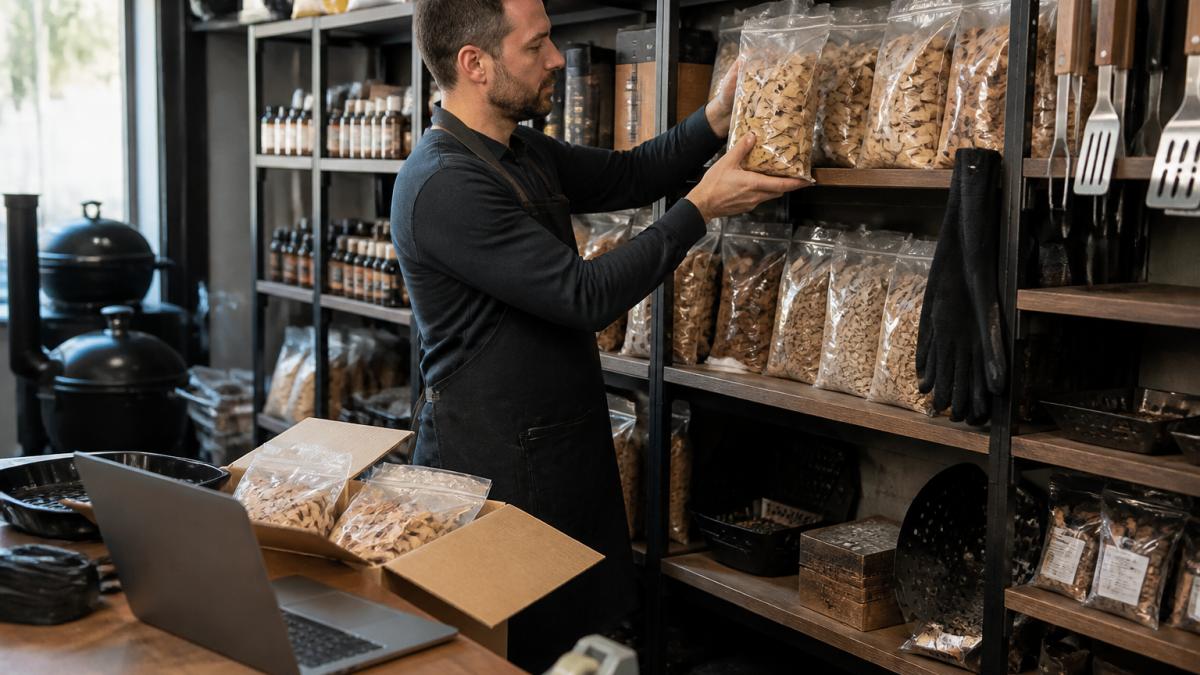
At Flame Grilling Products, a family-owned operation, our drop ship program allows businesses to sell premium grilling products without the burden of inventory management or shipping logistics.
Traditional wholesale means buying in case or pallet quantities, warehousing goods, and absorbing unsold inventory.
Three groups benefit most:
- New store owners testing whether BBQ gear fits their audience
- Established retailers adding a category without tying up cash
- Private label sellers who want their own brand without a warehouse
How to Start a Dropshipping Business for BBQ Gear
Starting a dropshipping business for BBQ gear follows a predictable path: pick a niche, set up order handling, then build supplier relationships. Your niche dictates which suppliers and logistics partners make sense.

Choosing a Niche: Grills, Wood, or Accessories
Grills are the hardest category to dropship: heavy, expensive to ship, and prone to damage claims. Wood and accessories are far friendlier.
Consumable wood has a natural advantage: customers reorder. A box of apple chunks for pork and beef produces a repeat buyer far sooner than a single grill. Accessories like cedar planks, smoker boxes, and chips share that sweet spot, light, cheap, and used up fast.

Setting Up Order Handling and Fulfillment
Order handling is where most new dropshippers lose customers: the workflow is simple, but the handoffs are not.
- Customer places an order on your store
- Your platform routes the order to your supplier
- The supplier picks, packs, and ships directly to your customer
- Tracking flows back to your store and into the customer's inbox
What most guides miss is packaging. If your supplier ships in plain, unbranded boxes, your customer sees a generic package, not your store. Ask about labeling and inserts before you commit.
How to Find the Best Grilling Wood Suppliers for Retailers
Freshness matters more here than in almost any other category. Wood that sits for months dries out and loses the aromatic oils that create smoke flavor.
Species range is the second filter. Our own runs from Maine Yellow Alder for seafood to Beechnut for beef and sausage.

The third filter is documentation. Ask for moisture specs, box weights, and shipping terms in writing.
Supplier Vetting Checklist: What to Verify Before You Commit
Most dropshipping supplier checklists are written for phone cases and t-shirts. Heavy, damage-prone, freshness-sensitive BBQ goods need different questions, built around the failure modes that actually cost BBQ retailers money: freight damage, stale wood, and unclear return liability.
Work through every item before you list a single product.
Legitimacy and Business Verification
- Business registration and resale certificate on file. Ask for the legal entity name, not just the storefront brand. Cross-check it against your state's business registry.
- Physical facility address, not a virtual mailbox. A supplier who cannot tell you where the product ships from cannot give you a realistic lead time.
- Insurance certificate covering shipped goods. For heavy items, this is the difference between a supplier eating a damage claim and you eating it.
Product and Freshness Verification
- Harvest-to-ship timing stated in writing for wood products.
- Moisture content spec for wood, typically expressed as a percentage range.
- Species list with sourcing region for each. "Hickory" from one region can taste different from another, and reordering customers expect consistency.
Order Handling and Fulfillment Terms
- No minimum order confirmed in writing, not just on a sales call. Verbal promises do not survive a change in account management.
- Daily order cutoff time in your supplier's time zone, so you can set accurate delivery expectations at checkout.
- Lead time in business days, with a separate number for peak season.
Damage, Returns, and Freight Liability
- Damage claim window in writing, with the exact number of days from delivery to file.
- Who pays return freight for a damaged unit, and who pays for a customer-remorse return, two different policies suppliers often conflate.
- Replacement vs. refund policy for large appliances. A replacement grill cart is not the same customer experience as a refund, and your reviews will reflect which you offer.
Pricing and Margin Transparency
- Wholesale pricing tiers published, so you can model margins before you sell.
- Shipping cost structure clear for both light and heavy items, including any free-shipping thresholds.
- Price change notice period. A supplier who can raise your cost overnight can wipe out a live listing's margin.
Run every candidate supplier through this list; the ones who resist documentation will cost you customers later.
Domestic vs. Overseas Sourcing and Lead Times
Domestic suppliers ship faster and handle returns more simply. Overseas suppliers quote lower unit costs, but the gap narrows once you add freight, customs, and a longer cash cycle.
| Factor | Domestic Supplier | Overseas Supplier |
|---|---|---|
| Typical lead time | Days | Weeks |
| Shipping cost for heavy goods | Predictable | Highly variable |
| Return handling | Straightforward | Often impractical |
| Freshness for wood products | Easier to guarantee | Hard to verify |
| Minimum order pressure | Often none | Usually high |
For heavy goods, domestic sourcing usually wins: freight savings from overseas evaporate once you ship a pallet of grilling wood or a bulky grill cart across an ocean. For light accessories like thermometer probes or grill brushes, the math can flip, and a hybrid mix is common.
Shipping Heavy and Bulky Items Without Killing Margins
Heavy and bulky items are where BBQ dropshipping margins go to die, a single damaged grill cart can wipe out the profit from several orders.
Start by knowing the actual shipped weight, not the product weight, packaging adds real pounds. Then check whether your supplier offers free or flat-rate ground shipping on the sizes you plan to sell.
For genuinely bulky items, consider a hybrid model: dropship the light, high-turnover products and stock the heavy ones locally in small quantities, keeping fast shipping on consumables while avoiding the worst freight costs on grills and carts.
Profit Margin Analysis and Return Policies for Large Appliances
Profit margin analysis for large appliances starts with the return rate, not the sale price. A grill with a high damage rate is not a high-margin product, no matter what the sticker says.
The Four Numbers That Decide Whether a Product Is Worth Listing
Build your margin model around four inputs, in this order:
- Landed cost per unit, including any inbound freight and duties.
- Outbound shipping cost, or written confirmation that the supplier covers it.
- Expected damage and return rate for the category.
- Payment processing and platform fees, typically a small percentage of the sale price plus a fixed per-transaction charge.
The order matters because the third number is the one most retailers underestimate.
Category Margin Patterns
Exact margins vary by supplier, brand, and season, but the pattern across BBQ categories is consistent:
- Consumable wood and fuel tends to carry the thinnest per-unit margin but the highest reorder rate. The profit comes from repeat purchases, not the first sale.
- Small accessories, grill brushes, thermometer probes, cedar planks, smoker boxes, usually carry the widest percentage margin and the lowest shipping cost. They are the easiest category to dropship profitably.
- Mid-size equipment, portable grills, griddle tops, pizza oven attachments, sits in the middle. Shipping is meaningful but manageable.
The takeaway: use small accessories and consumables to fund the business, and treat large appliances as a customer-acquisition play rather than a profit center unless your supplier's freight terms are unusually favorable.
Modeling a Single SKU
Run the four numbers against your sale price before you list anything. If the result is thin after a realistic damage rate, the product is not worth listing, no matter how good the wholesale price looks on paper.
Return Policies for Large Appliances
Return policy is not a customer-service detail in this category, it is a margin input deserving the same scrutiny as your wholesale price.
For large appliances, four questions decide your exposure:
- Who pays return freight? Freight on a full-size grill can exceed the profit on the sale. Get the answer in writing.
- What is the damage claim window? A short window means you must inspect and file fast. A long window gives you room to work with the customer.
- Is the remedy a replacement or a refund? A replacement keeps the revenue and the customer relationship. A refund ends both.
- Who files the freight claim, the supplier or you? If it is you, budget the time and the paperwork.
Where the Margin Actually Comes From
For most BBQ dropshippers, the durable margin is not in the grill, it is in the reorder. A customer who buys a box of apple chunks for pork and beef comes back sooner than one who buys a single grill, and the reorder carries no new acquisition cost. Build your mix so heavy, low-margin items bring customers in and light, high-margin consumables keep them coming back.
Building Long-Term Supply Reliability With Your BBQ Dropshipping Suppliers
Supply reliability is the difference between a side project and a real business.
Track two numbers from day one: order processing time and stockout frequency.
Finally, treat your supplier relationship like any long-term partnership: pay on time, communicate clearly, and give accurate order data.
Small retailers face a real challenge in BBQ e-commerce: heavy products, tight margins, and customers who expect fast delivery.
Frequently Asked Questions
Can you dropship BBQ equipment without a minimum order quantity?
Yes. Several BBQ dropshipping suppliers let retailers start with single-unit orders, which removes the upfront inventory risk that comes with bulk buying. This model suits small shops testing new product lines, since you only pay for what a customer has already ordered. The trade-off is usually a higher per-unit cost than wholesale bulk pricing, so run the numbers on profit margins before scaling.
What are the benefits of using a dropship program for grilling products?
The main benefits are no warehouse overhead, no upfront inventory spend, and no shipping logistics to manage yourself. For bulky items like grill carts or 33lb boxes of wood chips, that last point matters most, since storage and freight costs eat into margins fast.
How do I find reliable BBQ dropshipping suppliers in the industry?
Start with supplier verification: confirm the business address, ask for current lead times, and request a sample order before committing. Check whether they ship from a US warehouse or rely on consolidated shipping from overseas, since domestic delivery shortens lead times considerably. Ask how they handle shipping damage and returns on heavy goods, and get those terms in writing before you list their products.
Is it profitable to dropship BBQ accessories?
It can be, but the margin depends on product weight and shipping costs. Light accessories like grilling planks and wood chips ship cheaply and often come with free shipping from domestic suppliers, which protects your margins. Heavier items like portable barbecue units cost more to ship, so build shipping costs into your pricing model before you list them. Compare per-unit cost against resale price for each item.
What should I look for when choosing a dropshipping supplier for outdoor cooking gear?
Look for a supplier with domestic delivery, transparent lead times, and a clear return policy for large appliances. Confirm they can handle order processing and fulfillment without delays, and ask about packaging control if brand consistency matters to your store. A supplier that lets you start small and scale up is usually a better long-term partner than one demanding large upfront commitments.