

Table of Contents
- Why Wood Choice Makes or Breaks Your Smoke
- Toxic Woods You Should Never Use for Smoking Meat
- Can You Smoke Meat With Pine Wood?
- Can You Smoke Meat With Treated Wood?
- Green Wood vs Seasoned Wood for Smoking
- Safe Wood for Smoking Meat: What to Use Instead
- What to Do When You Don't Know the Wood Species
- Smoke Quality, Airflow, and Signs of Trouble
- Frequently Asked Questions
Last Updated: October 5, 2026
Why Wood Choice Makes or Breaks Your Smoke
The wrong wood can turn a $60 brisket into a bitter, sooty mess, which is why the first question to settle is: what wood should you not smoke meat with? That is the short answer to what wood should you not smoke meat with, and it is why we spend so much time on wood selection at Flame Grilling Products.
Toxic wood is any wood that releases harmful compounds when burned. Resinous wood is softwood packed with sap that turns acrid when it burns. Both categories can wreck your cook.
Here is the part most guides skip: the danger is not always the wood itself. Sometimes it is what was done to the wood before you bought it.
Toxic Woods You Should Never Use for Smoking Meat
Most guides hand you one long list of "bad woods" without distinguishing dangerous from merely bad-tasting. That distinction matters: a harsh flavor ruins dinner, but a toxic wood can send someone to the hospital.
Woods That Are a Genuine Health Concern
These woods release compounds that are harmful when the smoke is inhaled or when residue settles on food. Treat them as hard no's.
- Oleander (Nerium oleander). Every part contains cardiac glycosides, and burning aerosolizes those compounds.
- Yew (Taxus species). Contains taxine alkaloids. Wood, bark, and needles are all toxic, and its smoke is a recognized inhalation hazard.
- Poison oak, poison ivy, and poison sumac (Toxicodendron species). The urushiol oil that causes the rash survives burning. Inhaling the smoke can cause severe respiratory irritation and, in sensitive people, a systemic reaction. Never burn these anywhere.
Woods That Are Merely Unpleasant or Too Strong
These will not hurt you, but they will wreck the flavor of your cook. The mechanism is usually high resin, high tannin, or an oil that turns acrid under heat.
- Pine, fir, spruce, and most cedar (Pinus, Abies, Picea, Thuja). Resinous softwoods. The sap vaporizes and redeposits as a bitter, creosote-like coating. Pine is the worst offender because of its pitch content.
- Eucalyptus (Eucalyptus species). High in volatile oils that produce a medicinal, harsh smoke. Some species are also high in resin.
- Sassafras (Sassafras albidum). Contains safrole, which has raised health questions elsewhere. Most practitioners avoid it, and its strong root-beer flavor clashes with most meats.
The One Cedar Exception
Cedar is the most misunderstood wood on this list. Red cedar (Juniperus virginiana) and other aromatic cedars contain oils most pitmasters avoid for smoking. Northern white cedar (Thuja occidentalis) is different: non-toxic, low in resin, and used for grilling planks and chips, especially with salmon.

A Note on Common Names
"Cedar" can mean a dozen different trees. "Ironwood" can mean hop-hornbeam, mesquite, or something else depending on the region. "Pepperwood" is a nickname for several unrelated species. When you buy smoking wood, ask for the botanical name or buy from a supplier who labels it. A common name alone is not a safety guarantee.
Can You Smoke Meat With Pine Wood?
No. Pine wood should never be used for smoking meat. It is a resinous softwood whose sap produces acrid, bitter smoke that coats your food in compounds you do not want to eat. Pine also pops and throws sparks near an open fire, and even a little mixed with good hardwood taints the whole batch. Skip it entirely.
Can You Smoke Meat With Treated Wood?
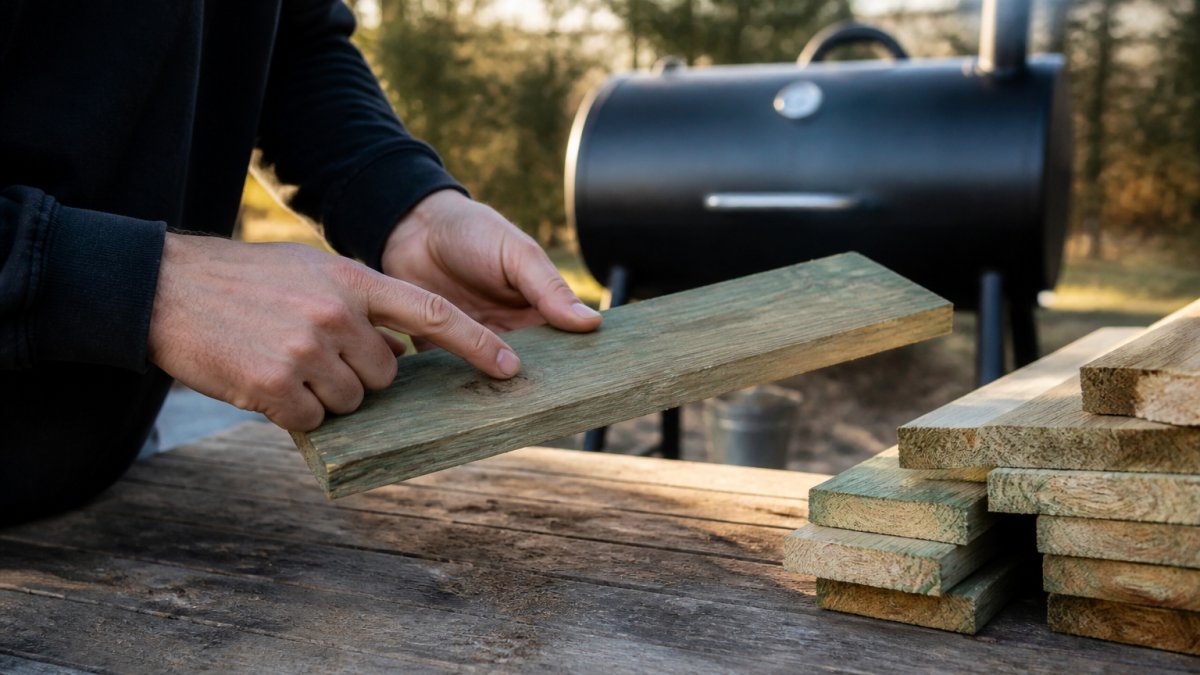
What wood should you not smoke meat with? Never smoke meat with treated, painted, glued, or stained wood. Pressure-treated lumber contains chemical preservatives that release toxic fumes when burned, and those fumes settle on the meat.
How to Spot Treated, Painted, or Glued Lumber
Check every piece of wood before it goes near your smoker. Look for these signs:
- Greenish or brownish tint running through the grain, a hallmark of pressure-treated wood.
- Paint, stain, or varnish on any surface, even a small patch.
- Glue lines or seams, which means it is plywood, particle board, or a glued panel.
If a piece fails any of these checks, it goes in the trash, not the smoker.
Green Wood vs Seasoned Wood for Smoking
Seasoned wood is dry and ready to burn; green wood is freshly cut and still full of moisture. For smoking, you want seasoned wood. Green wood smolders instead of burning clean, producing thick, white, bitter smoke that coats meat in creosote, and it burns unevenly, so temperatures swing.
Seasoned wood has dried for months, usually six to twelve months for split logs, so it ignites cleanly and gives off thin, blue smoke, the smoke you want.
How to tell if wood is seasoned:
- It is lighter than a green piece of the same size.
- The bark is loose or falling off.
- The ends show cracks radiating from the center.
Safe Wood for Smoking Meat: What to Use Instead
Safe wood for smoking meat means seasoned hardwood with a clean burn and a flavor you actually want: hickory, oak, apple, cherry, maple, pecan, and alder.
Here is how the main options compare:
Bulk Maine White Cedar Grilling Chips →
| Wood | Flavor Profile | Best For |
|---|---|---|
| Hickory | Strong, smoky, bacon-like | Pork, ribs, brisket |
| Oak | Medium, balanced, earthy | Beef, brisket, lamb |
| Apple | Mild, sweet, fruity | Chicken, pork, fish |
| Cherry | Mild, sweet, slight tartness | Poultry, pork, duck |
| Maple | Mild, sweet, light | Poultry, vegetables |
| Pecan | Rich, nutty, milder than hickory | Pork, poultry, beef |
| Alder | Delicate, slightly sweet | Salmon, fish, poultry |
One wood deserves a note: northern white cedar. Unlike red cedar, it is non-toxic and used for grilling planks and chips. It pairs especially well with salmon, and it is the wood we build our business around.

Matching Safe Woods to Meat and Flavor
Pick your wood to match the meat, not the other way around. Strong meats handle strong smoke. Delicate meats need a light touch.
- Beef and brisket: oak, hickory, pecan
- Pork and ribs: hickory, apple, cherry
- Chicken and poultry: apple, cherry, maple, alder
A common mistake is using hickory on everything. It overwhelms chicken and fish. Match the wood to the protein and the flavor stays balanced.
What to Do When You Don't Know the Wood Species
This is the most common real-world question in backyard smoking, and almost no guide answers it well. A neighbor drops off a truckload of "free wood," you inherit a stack from a garage, or you find an unlabeled bag at a yard sale. Here is a decision process that keeps you safe without throwing away good wood.
Step 1: Rule Out Contaminated Lumber First
Before identifying the species, rule out things that make wood unsafe regardless of the tree it came from. Check for these in order:
- Greenish or brownish tint running through the grain. This is the signature of pressure-treated lumber (chromated copper arsenate or newer copper-based treatments). If you see it, stop. Do not cut, sand, or burn it.
- Paint, stain, varnish, or sealant on any surface, even a small patch. Sanding does not make it safe. The chemicals have soaked into the grain.
- Glue lines, seams, or a layered edge. This means plywood, particle board, MDF, or a glued panel. The binders release formaldehyde and other compounds when burned.
If a piece fails any of these checks, it goes in the trash, not the smoker. There is no salvage method.
Step 2: Try to Identify the Species
If the wood passes the contamination check, you can attempt identification. This is not foolproof, but it narrows the field.
- Look at the end grain. Hardwoods have visible pores (tiny holes) on a cut end; softwoods look smooth and uniform, with growth rings but no pores. A cheap 10x jeweler's loupe helps.
- Check the weight. Softwoods feel noticeably lighter than hardwoods of the same size; dry pine is roughly half the density of dry oak.
- Smell a fresh cut. Hardwoods like oak, hickory, and fruit woods smell clean and slightly sweet or earthy. Softwoods smell like pine, sap, or turpentine.
Step 3: Apply the Decision Rule
Once you have checked contamination and made your best guess at species, use this rule:
- Confirmed safe hardwood, clean and seasoned: use it.
- Confirmed softwood or resinous wood: do not smoke with it. It can go in a fire pit or a brush pile.
- Unknown species but passes the contamination check and looks and smells like a clean hardwood: use it for a test cook on a cheap cut before committing a brisket. If the smoke smells acrid or the flavor is off, stop.
Step 4: Build a Labeling Habit
The long-term fix is to never be in this situation again. Keep a labeled bin for each wood species in your shop or garage, and put loose wood in an "unknown" bin until you can identify it. Never mix unknown wood into your smoking stock. If you buy in bulk, ask the supplier for the species name and the harvest or seasoning date, and write it on the container.
Smoke Quality, Airflow, and Signs of Trouble
Good smoke is thin and blue; bad smoke is thick and white. Thin blue smoke means the wood is burning clean and hot.
Signs of trouble to watch for:
- White, billowing smoke for more than a few minutes at startup.
- A bitter or ashy taste on the bark.
- Meat that looks black and sooty rather than deep mahogany.
Fix airflow before adding more wood. Open the vents, clear the ash, and let the fire breathe. Excess smoke does not add flavor; it adds creosote.
Choosing the right wood is the difference between barbecue people remember and barbecue they politely finish. Our Bulk Maine White Cedar Grilling Chips and White Cedar Grilling Planks give you a clean, non-toxic option for salmon, poultry, and more.

Frequently Asked Questions
Can I smoke meat with regular wood from my backyard?
Only if you can confirm the species is a safe hardwood like oak, hickory, or maple, and that it has not been treated, painted, or glued. Wood from unknown trees, construction scraps, or pallets often carries chemical contamination. When in doubt, buy labeled smoking wood from a supplier who identifies the species and confirms it is food-safe wood.
Can you smoke meat with pine wood?
Pine is a softwood loaded with resin and sap. Burning it produces acrid smoke that coats meat in a bitter, sooty taste. It also creates heavy creosote buildup inside your smoker, which is difficult to clean and can affect future cooks. Pine is not a safe wood for smoking meat. Stick with hardwoods like apple, cherry, or hickory instead.
Is moldy or rotten wood safe to use in a smoker?
No. Moldy or rotten wood can harbor mold spores and bacteria that transfer to your food through smoke. Even if the meat reaches a safe internal temperature, the flavor turns musty and unpleasant. Discard any wood with visible mold, soft spots, or a damp, earthy smell. Store smoking wood in a dry, ventilated area to prevent spoilage.
Can wood be too dry for smoking meat?
Yes. Kiln-dried or very old wood can burn too hot and fast, producing harsh smoke with little flavor. The ideal moisture content for smoking wood is around 15 to 20 percent. Seasoned wood that has air-dried for six to twelve months usually lands in that range. If your wood snaps easily and feels lightweight, it may be too dry.