

Quick Summary
To keep wood moisture consistent, store wood in a ventilated space where humidity stays steady, and check its moisture content regularly against the target for its use. Wood gains and loses water as the surrounding air changes, so matching its storage conditions to a stable equilibrium moisture content keeps it from swelling, shrinking or cracking.
- Wood gains and loses water as relative humidity and temperature change around it.
- Cooking and smoking wood is generally seasoned to the high teens to low twenties percent range.
- Indoor furniture and flooring typically targets 6 to 9 percent in heated homes.
- Take meter readings at several points on each board, avoiding knots and sap pockets.
- Adjust the storage air first, since heat or direct fans can cause checking.
Table of Contents
- Why Wood Moisture Content Changes and Why It Matters
- Acceptable Moisture Levels for Wood by Use
- Using a Wood Moisture Meter Correctly
- Moisture Content of Wood Chart: Reading Your Results
- Step-by-Step Routine to Monitor and Adjust Moisture
- How to Store Wood to Prevent Moisture Changes
- Troubleshooting Moisture-Related Defects in Wood
- Setting Up Your Wood Moisture Routine
- Frequently Asked Questions
One question we hear often is how to keep wood moisture steady from delivery to fire. Wood that swings between too dry and too damp burns unevenly, smokes inconsistently and can crack or warp in storage.
Wood moisture content is the weight of water in a piece of wood as a percentage of its oven-dry weight. Department of Agriculture Forest Service explains that this exchange depends on the air's relative humidity and temperature, as well as the wood's current moisture content (USDA Forest Service research on moisture relations and physical properties of wood).
Why Wood Moisture Content Changes and Why It Matters
Wood moisture never sits still. Wood that can hold up in damp conditions is covered in our guide to which woods to avoid smoking with. Every board constantly tries to reach balance with the surrounding air, and that balance shifts with the weather, the season and the room it sits in.
How wood absorbs and releases moisture
Wood acts like a sponge that responds to the air. When humidity is high, wood picks up water. When the air is dry, wood gives it back. This cycle repeats all year.
Two things drive the cycle. The first is relative humidity, the amount of water vapor in the air compared to what the air can hold at that temperature. The second is temperature, which changes how much moisture the air can carry.
Shifts in moisture cause the wood to shrink and swell, which is why moisture control matters so much for smoking and grilling.
Equilibrium moisture content and wood movement
Equilibrium moisture content, often shortened to EMC, is the moisture level wood settles at when it stops gaining or losing water to the air around it (Chapter 13: Drying and control of moisture content and dimensional changes).
This is why a board stored in a damp garage may swell and a board stored in a heated room may dry out and split. The goal is not zero moisture.
Acceptable Moisture Levels for Wood by Use
The right moisture target is not one number. It depends on what the wood is for, what species it is, and what the local air is doing where it will live. A target that is correct for a smoker in a humid summer can be wrong for a cabinet in a heated room in January. Use the ranges below as starting points, then confirm against your own storage conditions and the equilibrium moisture content (EMC) the wood will actually see.
Practical target ranges by use
- Cooking and smoking wood: Most practitioners aim for seasoned fuel wood in the high teens to low twenties percent moisture content. Wood in roughly the 15 to 20 percent range lights and burns with less smoke and creosote than green wood, while wood below about 10 percent can burn hot and fast and lose some of the smoke character that flavor matters for. Very dry wood also reabsorbs moisture quickly in humid storage, so a slightly higher stable target is often easier to hold than a bone-dry one.
- Indoor furniture, cabinetry, and flooring: The common shop target is 6 to 9 percent in heated, air-conditioned homes, and closer to 8 to 12 percent in homes without central climate control or in damp regions. The wood should be within about 2 percentage points of the EMC of the room where it will be installed. A board that reads 12 percent going into a 7 percent room will shrink and open gaps as it dries in place.
- Outdoor structures, fencing, and framing: Higher moisture is tolerable because the wood will track outdoor humidity anyway. Targets in the 12 to 19 percent range are common for structural lumber, with the understanding that the wood will swell and shrink seasonally. Protection from direct rain and standing water matters more than hitting a precise number.
Why species and climate shift the target
Different species hold different amounts of bound water at the same humidity, and dense species move more slowly than light ones. A common pattern is that dense hardwoods such as oak and hickory take longer to acclimate and can check more aggressively if dried too fast, while softer species such as pine and cedar equalize more quickly.
Climate matters just as much. In a humid summer, unconditioned storage may sit near 12 to 14 percent EMC, so chasing a 6 percent target there is wasted effort and may just crack the surface.
How to confirm your target
- Measure the temperature and relative humidity in the storage or use space with a thermo-hygrometer.
- Look up or estimate the EMC for that combination; most wood science references publish EMC tables keyed to temperature and relative humidity.
- Compare your meter readings to that EMC. If the wood is more than about 2 percentage points away, give it time to acclimate before use.
- Recheck after a week and again after a season change, since the target itself moves with the weather.
Watch out: a single chart number applied to every project is the most common cause of gaps, cupping, and cracks. Treat any published range as a starting point and adjust it to your species, your climate, and the room the wood will actually live in.
The table below sums up the target moisture ranges the article gives for each use.
| Use | Target moisture content | Key note |
|---|---|---|
| Cooking and smoking wood | High teens to low twenties percent | Below about 10 percent burns hot and fast |
| Indoor furniture, cabinetry, flooring | 6 to 9 percent (heated homes) | 8 to 12 percent without central climate control |
| Outdoor structures and framing | 12 to 19 percent | Protection from rain matters more than precision |
| Turning blanks and green woodworking | 20 percent and up | Dry gradually; do not apply indoor targets |
Using a Wood Moisture Meter Correctly
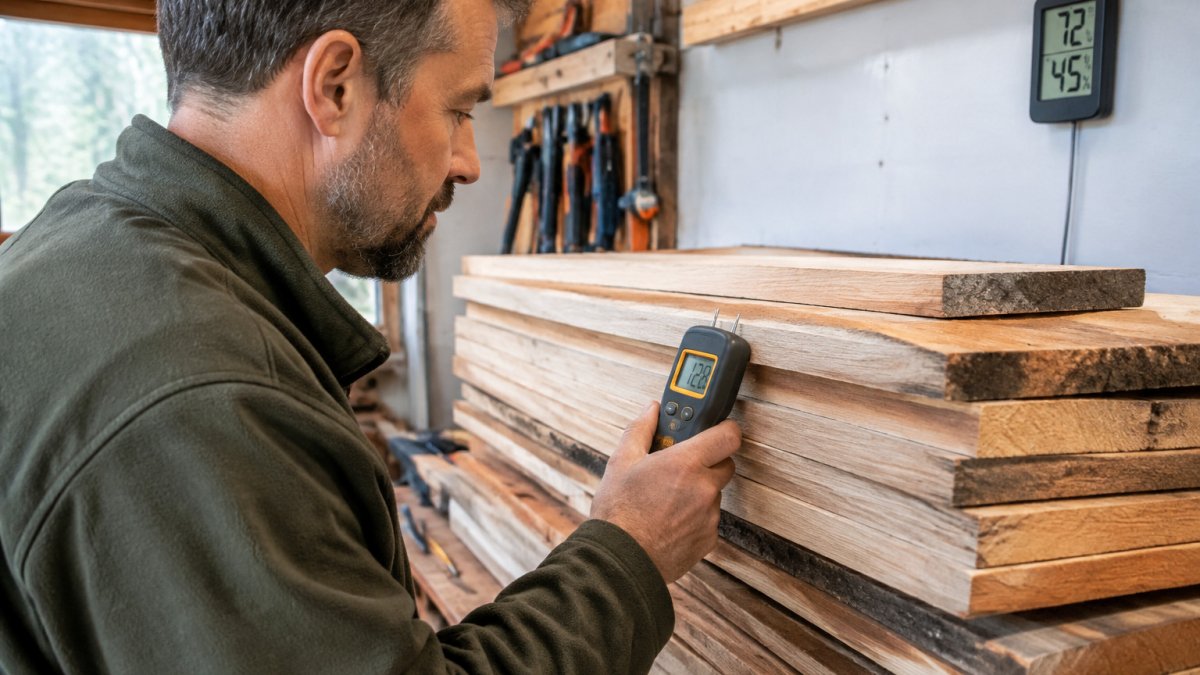
A moisture meter is the fastest way to see where your wood stands. Pin-type meters push small probes into the wood and read the electrical resistance between them.
For the most reliable reading:
- Take readings at several points on each board, not just one
- Avoid knots, sap pockets and recent finishes, which skew results
- Check the meter's calibration for the wood species you are testing
The North Carolina State University wood science program notes that consistent, accurate measurement needs a standard procedure, and that the oven-dry method defines true moisture content (NC State research on methods of moisture content measurement).
Moisture Content of Wood Chart: Reading Your Results
Once you have a reading, you need to know what it means. A moisture content chart lists target ranges by use and helps you decide whether a board is ready, too wet or too dry.
Read your results with three questions in mind:
- Is the reading within the target range for my use?
- Is the reading stable across several test points?
- Is the reading drifting over days or weeks?
A stable reading inside your target is good news. A reading that keeps climbing or falling tells you the storage area is moving the wood away from balance, and that needs attention.
Step-by-Step Routine to Monitor and Adjust Moisture
Most guides give isolated tips. What actually keeps wood stable is a repeatable schedule: measure the air, measure the wood, record both, compare to target, and adjust before the wood drifts. The routine below is built to be run in a few minutes and repeated on a fixed cadence so you catch changes early.
What you need
- A pin or pinless moisture meter, calibrated for the species you are testing
- A thermo-hygrometer to read temperature and relative humidity in the storage space
- A simple log, a notebook, spreadsheet, or phone note, with columns for date, location, temperature, relative humidity, meter readings, and action taken
The weekly routine
- Read the room first. Place the thermo-hygrometer at wood height, not on the floor or near a vent, and record temperature and relative humidity. These two numbers tell you which way the wood is being pushed before you even test it.
- Test the wood at multiple points. Take readings at several spots on each board or piece, avoiding knots, sap pockets, and fresh finishes. For thick stock, test near the surface and, if your meter allows, at depth; surface readings can lag the core.
- Record every reading. Write down the numbers rather than remembering them. A log is what turns a single reading into a trend, and the trend is what tells you whether the storage is working.
- Compare to target. Check the readings against the target range for your use and against the EMC implied by the room's temperature and humidity. A reading inside the range and stable across points is good. A reading drifting in one direction is a signal.
- Adjust the air, not the wood. If humidity is too high, improve ventilation, add a fan, or run a dehumidifier. If it is too low, add humidity, move the wood away from heat sources, or relocate it to a damper space. Change the environment first; forcing the wood with heat or direct fans causes checking.
- Retest after a week. Confirm the wood is moving toward target, not past it. If it overshoots, reverse the adjustment gently.
The seasonal and room-by-room layer
A weekly check is the baseline, but the target itself moves with the season and the room. Run a fuller check at each season change, and anytime wood moves to a new space.
- Heated rooms in winter: Indoor EMC can fall toward 4 to 6 percent. Wood brought in from a damp garage will dry and shrink fast, so acclimate it gradually and expect gaps or checking if it is rushed.
- Basements and garages: These often run damp and cool, with EMC in the 12 to 14 percent range or higher. Ventilation and a dehumidifier do more good than heat.
- Humid climates and summer: Unconditioned storage may sit near 12 to 14 percent EMC. Chasing a very low target there is wasted effort; aim for stable and slightly higher rather than bone-dry and cracking.
Reading the trend, not just the number
A single reading tells you where the wood is. A log tells you where it is going. Three patterns matter:
- Stable inside target: leave it alone and keep the weekly check.
- Climbing over days or weeks: the storage is too damp; ventilate, dehumidify, or move the wood.
- Falling over days or weeks: the storage is too dry or too warm; add humidity, move it away from heat, or relocate it.
Watch out: adjusting with direct heat or a fan pointed at the wood can dry the surface faster than the core, which causes checking and case hardening. Change the room's air gradually and let the wood follow.
How to Store Wood to Prevent Moisture Changes
A single reading tells you where the wood is; a log tells you where it is going. Three patterns matter:
Good air circulation prevents damp pockets. Stack wood with gaps between boards so air can pass through.
Store wood for cooking in a dry, ventilated spot.
Troubleshooting Moisture-Related Defects in Wood
Moisture problems show up in predictable ways. Watch for these signs:
- Cupping: Board edges curl up, usually from moisture on one face
- Checking: Small surface cracks, often from drying too fast
- Warping: Twisting or bowing across the length of a board
When you spot a defect, find the cause first. Check the humidity where the wood is kept, look for water sources such as leaks or condensation, and confirm the wood was acclimated before use. Fix the environment before you blame the wood.
Setting Up Your Wood Moisture Routine
A consistent routine turns moisture control from guesswork into a habit. Pick one storage spot, buy a meter and a thermo-hygrometer, and schedule a monthly check.
Start with the basics, measure often and adjust before problems grow.
Get your moisture routine running with Flame Grilling Products, a family-owned supplier of fresh, sustainably sourced grilling wood, and build a steady supply your customers can count on.
Frequently Asked Questions
How long can wood retain moisture?
Wood keeps moisture until conditions around it change. Its moisture content shifts toward equilibrium with the surrounding air, so thick or dense pieces can take weeks or months to fully settle after a change in relative humidity. Oven-dry testing is the reference method, and a moisture meter gives a quick reading to track progress. Checking readings over several days shows whether the wood is still drying or has stabilized.
What is the acceptable moisture level for wood?
Acceptable moisture levels for wood depend on how it will be used. Interior wood products such as flooring and furniture are usually acclimated to the moisture content that matches the home's typical relative humidity, often in the range of roughly 6% to 9%. Wood that will be used outdoors or in humid spaces may need a different target. Check the species, end use, and local climate before setting a goal, and use a moisture content of wood chart to compare readings.
How often should you check wood moisture with a meter?
Check wood moisture with a meter at the start of a project, after any change in storage conditions, and before you install or use the wood. During acclimation, check every day or two until readings level off. Once the wood is stable, a weekly or seasonal check is usually enough, especially when indoor humidity changes with heating or air conditioning. Record readings so you can spot trends early.
Does wood moisture content change with humidity?
Yes. Wood gains or loses moisture as the relative humidity and temperature of the surrounding air change. Higher humidity raises equilibrium moisture content, which causes wood to swell, while lower humidity causes shrinkage. Keeping indoor humidity steady and letting wood acclimate before use reduces warping, cupping, and cracking.
