
Table of Contents
- Why Sustainable Smoking Wood Changes Your Results
- How to Identify Firewood Species Before You Buy
- Firewood Moisture Content for Smoking: What to Measure and How
- Food-Safety and Treatment Checks for Smoking Wood
- Firewood Sourcing Questions to Ask Suppliers
- Step-by-Step: Verifying a Supplier and Product Before You Commit
- Regional and Ecological Considerations for Smoking Wood
- Conclusion: Building a Reliable Sustainable Smoking Wood Supply
- Frequently Asked Questions
Last Updated: October 7, 2026
Why Sustainable Smoking Wood Changes Your Results
Learning how to identify sustainably sourced firewood for smoking starts with one hard truth: the wood you burn ends up in the food you eat.
At Flame Grilling Products, we have cut and shipped smoking wood since 2001. Wood from a well-managed woodlot burns cleaner and tastes better. Wood of unknown origin is a gamble.
Here is what most guides get wrong: they treat "sustainable" as a label you either trust or don't. In practice, it is a set of things you can check yourself, before you spend a dollar.
Below, we break down species, moisture, safety checks, and the exact questions to ask a supplier.
How to Identify Firewood Species Before You Buy
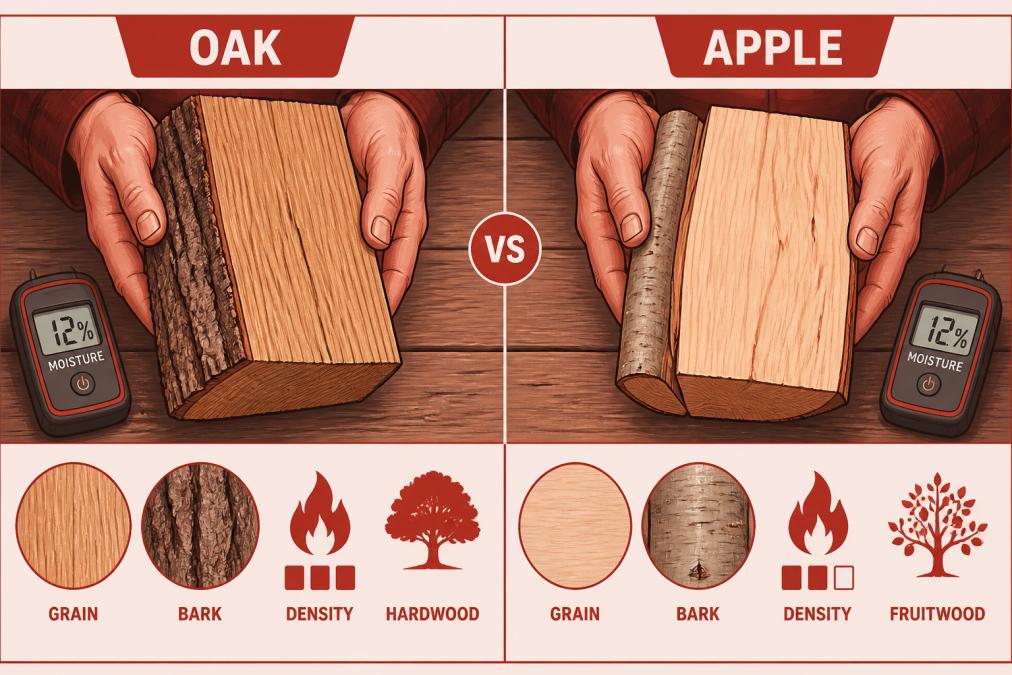
Species identification is the skill that separates confident buyers from hopeful ones. You can name most smoking woods by looking at three things: bark, grain, and end grain. No lab test needed.
Reading Bark, Grain, and End Grain
Start with the bark. Red oak has deep, dark ridges. Apple has thin, scaly bark that curls. Maple is smooth and gray on young trees, rougher on old ones.

Then look at the split face. Oak shows wide rays and a coarse texture. Fruitwoods like apple are tight and fine. Alder is soft and pale, almost buttery in color.
Finally, check the end grain. Growth rings tell you how fast the tree grew. Tight rings usually mean denser, slower-grown wood, which often burns longer.
A common mistake is judging by color alone. Fresh-cut wood changes color as it dries, so bark and grain are more reliable clues.
Matching Species to Flavor: Oak, Apple, Maple, Alder, and Pecan
Each species brings a different flavor profile. Match the wood to the food:
- Oak: mild, nutty, slightly vanilla. Great for beef, white fish, and cheese.
- Apple: sweet and fruity. Best for pork, poultry, and game.
- Maple: sweet, mellow smoke. Ideal for ham and turkey.
- Alder: light wintergreen note. A classic for seafood.
- Pecan: rich and nutty, a bit stronger. Good for brisket and ribs.
Buying mixed hardwood without knowing the mix is a risk. You cannot match flavor if you cannot name the species.
Firewood Moisture Content for Smoking: What to Measure and How
Firewood moisture content for smoking should sit below 20 percent. Wet wood smokes poorly, creates creosote, and leaves a bitter taste. Dry wood burns hot and clean.
You do not need a lab. A basic moisture meter costs little and tells you almost everything. Split a piece of wood and press the meter pins into the fresh inner face, not the outside.
Here is how to read it:
- Below 20 percent: ready to smoke.
- 20 to 25 percent: borderline, needs more drying.
- Above 25 percent: not ready, expect heavy smoke and poor heat.
Split ends, a faded gray surface, and visible cracks are good signs of dry wood. But looks can fool you. Always confirm with a meter.
Kiln-Dried vs. Air-Dried: Sustainability Trade-Offs
Kiln-dried wood gets its moisture removed in a heated chamber. It is consistent and ready fast, but the process uses energy. Air-dried wood sits in stacked, covered piles for months. It uses no added energy but takes patience and space.
The sustainability trade-off is real. Kiln drying can be efficient at scale, while air drying saves fuel but ties up land and time. Neither is automatically "greener." What matters is how the supplier manages the whole process, from harvest to delivery.
For smoking, both work if moisture lands below 20 percent.
Food-Safety and Treatment Checks for Smoking Wood
Smoking wood must be untreated and food-safe. This is the check most buyers skip, and it is the one that matters most for safety.
Watch for these red flags:
- Painted, stained, or varnished wood
- Pressure-treated lumber
- Wood from pallets or construction scrap
- Wood with glue, nails, or chemical smells
Any of these can release harmful fumes when burned. Never smoke with them.
Ask your supplier directly: Is this wood untreated and food-safe? A reputable seller will answer without hesitation. If they dodge the question, walk away.
Firewood Sourcing Questions to Ask Suppliers
Good suppliers welcome questions. Vague answers are a warning sign. But the questions themselves have to be sharp enough to expose a weak supply chain. Use these firewood sourcing questions to ask suppliers before you buy, and pay attention to how the answer is delivered as much as what is said.
On origin and harvest method:
Bulk Maine Yellow Alder Grilling Chunks →
- Where, specifically, was this wood harvested? A county, a state, or a named woodlot beats "domestic" or "local."
- Was it taken from a managed woodlot, a thinning operation, a storm-damaged stand, or a clear-cut? Each has a different sustainability profile.
- Who owns the land, and is the harvest permitted? Commercial timber harvests on public land require a permit or contract, and private woodlots often operate under a written management plan. Ask whether one exists.
- Is the operation certified? Look for Forest Stewardship Council (FSC) or Sustainable Forestry Initiative (SFI) chain-of-custody certification. These are the two dominant forest-management certification programs in the United States, and both publish searchable databases of certified operations. A supplier who claims certification should be able to point you to a certificate number you can look up.
On species and traceability:
- Can you name every species in a mixed order, by percentage? "Mixed hardwood" is not an answer.
- Can you trace this specific batch back to the harvest? A supplier with real traceability can tell you the species, the harvest date, and the drying method for the lot you are buying.
On drying and moisture:
- What is the moisture content, and how do you measure it? Ask for a number and the method, a pin-type meter reading on a freshly split face is the standard.
- Was the wood kiln-dried or air-dried, and for how long?
On food safety and additives:
- Is the wood untreated and food-safe? This matters more for smoking than for heating, because smoke deposits land directly on food.
- Was anything applied to the wood, a mold inhibitor, a pest treatment, a finish, or a fragrance? Any "yes" is a disqualifier for smoking.
- How is the wood stored and shipped? Look for answers that mention covered storage off the ground and packaging that keeps moisture out.
How to evaluate the answers:
A strong supplier answers in specifics, names, numbers, dates, certificate numbers. A weak supplier answers in adjectives: "premium," "all-natural," "sustainably harvested." Adjectives are not verifiable. If a supplier cannot or will not name a harvest location, a species list, a moisture number, and a certification status, treat the sustainability claim as marketing until proven otherwise.
Step-by-Step: Verifying a Supplier and Product Before You Commit
Verification takes minutes and saves headaches. Follow these steps in order:
- Ask for the harvest location. A specific region beats a vague "domestic" answer.
- Request the species list. You should get real names, not "mixed hardwood."
- Confirm moisture content. Ask for a number, not "it's dry."
- Check food-safety claims. Untreated and food-safe should be stated plainly.
- Order a small test batch. Smoke one meal before committing to bulk.
- Inspect on arrival. Look for mold, dirt, and off smells.
- Test with a meter. Confirm the moisture yourself.
If a supplier passes all seven, you have found a keeper.
Our wood comes from family farm wood lots within a 30-mile radius, cut fresh and shipped daily. For buyers who want to skip the guesswork, our Bulk Maine Wild Apple Grilling Chunks and Bulk Maine Sugar Maple Grilling Chunks are good starting points.

Regional and Ecological Considerations for Smoking Wood
Where wood comes from shapes how sustainable it really is, and for smoking wood, it also shapes what pests and pathogens you may be moving around. This is the part of sourcing most guides skip.
Pest and disease movement is the big one.
Moving untreated firewood long distances is one of the most common ways invasive insects and diseases spread.
Local sourcing is not just about shipping miles.
Buying species native to your region usually means fresher wood, less time in transit and storage, and a lighter footprint. It also means you are not introducing a species, or a pest, to an area where it does not belong. Alder, for example, thrives in cool, wet climates.
What responsible harvest looks like on the ground:
- Harvesting from managed woodlots under a written plan, not clear-cutting
- Thinning stands and removing storm-damaged or diseased trees
- Using pruned branches and culled trees rather than felling whole stands
- Leaving enough standing and downed deadwood for wildlife and soil health
- Matching the harvest rate to what the land can regrow
The kiln-dried versus air-dried transport nuance.
Kiln-dried wood can travel farther without spoiling because its low moisture content makes it less hospitable to mold and insects, and heat treatment can satisfy some state movement requirements.
Conclusion: Building a Reliable Sustainable Smoking Wood Supply
Sourcing wood you can trust takes a little work up front, but it pays off in every cook. Species, moisture, food safety, and origin are the four pillars, and each one is checkable.
That is the standard we hold at Flame Grilling Products. Our family farm wood lots, fresh-cut supply, and free shipping across the USA make it easy to stock smoking wood you can stand behind. Our Bulk Maine Red Oak Grilling Chunks and Bulk Maine Yellow Alder Grilling Chunks cover the two most common smoking needs, beef and seafood.

Get started with Flame Grilling Products and build a smoking wood supply you never have to second-guess.
Frequently Asked Questions
What moisture level should smoking wood have?
Smoking wood should read below 20 percent moisture content on a meter, with 15 to 18 percent being ideal for clean combustion. Wood above 20 percent produces excess smoke, creosote buildup, and bitter flavors on your meat. Test by splitting a chunk and pressing the meter pins into the freshly exposed face, not the end grain. If you do not own a meter, knock two splits together: seasoned wood cracks sharply, while green wood thuds.
How can I tell whether firewood was sustainably harvested?
Ask your supplier directly about their harvest practices. A sustainable operation can tell you where the wood came from, whether it was standing timber or storm-damaged trees, and how they manage regrowth. Look for wood sourced from family farm wood lots or operations that thin stands rather than clear-cut. Flame Grilling Products, for example, sources wood from family farm wood lots within a 30-mile radius and delivers fresh wood daily, which gives you a verifiable origin story.
Can you use regular firewood in a smoker?
You can, but only if it meets two conditions: it is a food-safe hardwood species with no added chemicals, and its moisture content is below 20 percent. Regular firewood sold for heating may include softwoods, treated lumber, or painted scraps that release harmful compounds. Stick to known smoking species like oak, apple, maple, pecan, or alder. If you cannot confirm the species and treatment history, do not put it in your smoker.
Which wood species are best for smoking meat?
Hardwoods dominate: oak gives a mild nutty flavor, apple and other fruitwoods add sweetness, maple brings a gentle sweetness, and alder delivers a mild wintergreen note that suits seafood. Flame Grilling Products sells Maine Yellow Alder chunks ($93.99), Maine Wild Apple chunks ($35.99), Red Oak chunks ($35.99), and Sugar Maple chunks ($35.99), each in 15 lb or 45 lb boxes with free shipping. Match the species to the protein for the best result.