

Quick Summary
The best grilling wood for a restaurant menu is the one whose smoke profile, format, and supply stay consistent across months of orders. Hickory suits bold beef and pork, red oak and sugar maple suit poultry and fish, and apple wood suits pork and poultry. Kitchens usually stock chips for quick grills and chunks for long smoking runs.
- Restaurant buyers choose wood by specification: burn rate, smoke intensity, moisture consistency, and supply.
- Hickory gives strong, savory smoke for beef brisket, pork shoulder, and ribs.
- Red oak offers a nutty smoke suited to white fish, poultry, and cheese.
- Chips ignite fast for shorter cooks, while chunks burn steadily for long smoking runs.
- Retest every pairing whenever the wood format or supplier changes.
Table of Contents
- How Restaurant Grilling Wood Differs From Backyard Choices
- Hickory: Strong, Savory Smoke for Beef and Pork
- Red Oak and Maple: Versatile Woods for Poultry and Fish
- Apple Wood for Smoking: Sweet Fruitwood for Pork and Poultry
- Wood Chips vs. Chunks for Grilling in a High-Volume Kitchen
- Grilling Wood Food Pairings for a Consistent Menu
- Buying and Stocking Grilling Wood in Bulk for Your Restaurant
- Frequently Asked Questions
How Restaurant Grilling Wood Differs From Backyard Choices
A restaurant grill runs for hours, five or six days a week, and every plate has to taste the same on a Tuesday lunch as it does on a Saturday dinner rush. Backyard cooks pick wood by mood. Restaurant buyers pick wood by specification: burn rate, smoke intensity, moisture consistency, and how well a supplier can hold the same product across months of orders.
That difference changes what matters. A home griller might happily use a handful of mesquite once a month. A kitchen going through several boxes a week needs a wood whose smoke profile stays predictable, whose format fits the equipment, and whose supply will not run out in July. Many restaurant teams find that a wood with a mild, forgiving smoke gives them more room to match menu items than a bold wood that overwhelms delicate proteins.
Volume also changes the economics. Wood that costs a little more per pound can still be the cheaper choice when it burns cleanly and needs fewer adjustments on the line. When you cook for hundreds of covers, consistency is the real cost to control.
Hickory: Strong, Savory Smoke for Beef and Pork
Hickory is the workhorse of the category. Its smoke is strong and savory, which suits beef brisket, pork shoulder, and ribs that need a bold, traditional profile. Our Bulk Maine Atlantic Hickory Grilling Chips are packed in a 15 lb box or a 33 lb box, with free ground shipping in the USA.
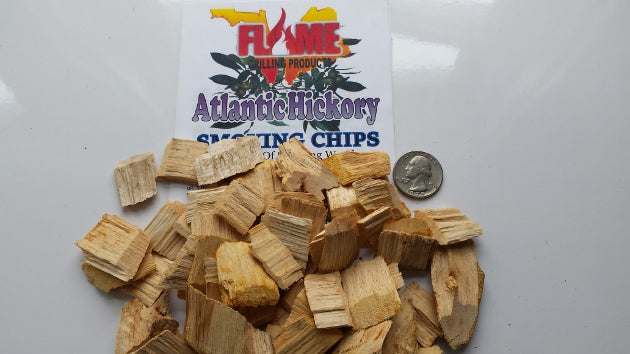
The risk with hickory is intensity. On a high-volume grill it can dominate a delicate item quickly, so many kitchens reserve it for proteins that can carry the smoke.
Red Oak and Maple: Versatile Woods for Poultry and Fish
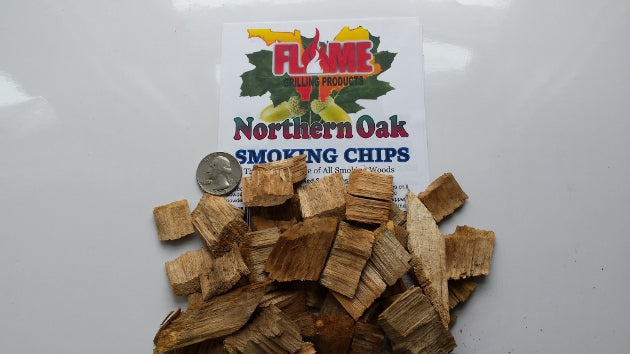
Red oak offers a nutty smoke with a hint of vanilla, which makes it a good choice for white fish, poultry, and cheese. Our Bulk Maine Red Oak Grilling Chips are packed in 10 lb or 33 lb boxes at $29.99.
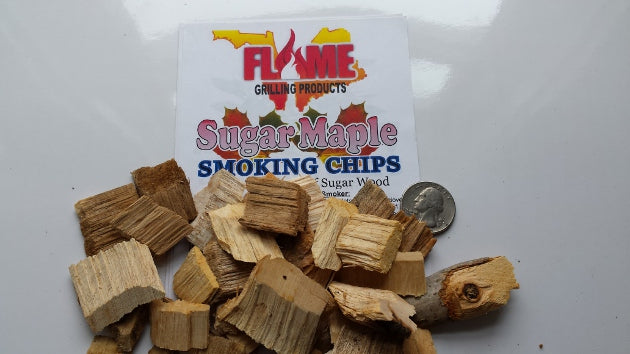
Sugar maple has a sweet smoke that suits pork or poultry. Our Bulk Maine Sugar Maple Grilling Chips are $29.99 in 10 lb or 33 lb boxes.
Apple Wood for Smoking: Sweet Fruitwood for Pork and Poultry
Apple wood brings a sweet, fruity smoke that pairs well with pork, poultry, and game.
Our Bulk Maine Wild Apple Grilling Chunks are sold in 15 lb and 45 lb boxes starting at $35.99, with free shipping in the USA. Browse bulk wild apple grilling chunks to compare box sizes. Maine Wild Apple Wood chunks are ideal for long propane grilling or smoking. Place the wood chunks directly onto the grilling surface, and use low heat with smoking chunks.
Wood Chips vs. Chunks for Grilling in a High-Volume Kitchen
Chips ignite quickly and produce smoke fast, which makes them useful for shorter cooks and for adding flavor late in service. Chunks burn slowly and steadily, which suits long smoking runs where you do not want to refuel the box every twenty minutes.
Most commercial kitchens end up using both. Chips handle quick grills and finishing smoke, and chunks carry brisket or whole birds through the night. Before you buy either in bulk, confirm your smoker box or grill setup, since chunk size and chip size behave differently in each.
Grilling Wood Food Pairings for a Consistent Menu
Pairings are the easy part; repeatability is the hard part. Build your wood program around the proteins you cook most, then prove each pairing on the same protein, portion, and cook method before it goes on a menu.
Start with the pairings that carry volume. Maine yellow alder chips, priced at $84.99 per 10 lb or 33 lb box, have a distinct smoke that goes well with seafood. The product listings describe pairings for beef, pork, poultry and seafood across the catalog.
Write the pairing into the recipe card. Once a wood is chosen, put the wood, format (chips or chunks), approximate pounds per batch, and vent or airflow notes on the recipe card next to the protein. That keeps every cook on the line working from the same plan and makes it obvious where one wood can cover several items, which simplifies purchasing. It also gives new staff a written standard instead of a verbal one.
Watch out: a pairing that tastes right on a single test cook can drift once the wood format changes, swapping chips for chunks on the same protein changes smoke intensity and timing, so retest whenever the format or supplier changes. For a broader look at smoking woods for long cooks, see our guide to Best Smoking Woods for Long Cooks: 7 Top Picks.
Buying and Stocking Grilling Wood in Bulk for Your Restaurant
For a restaurant, purchasing grilling wood is a specification decision. Build the program in four steps.
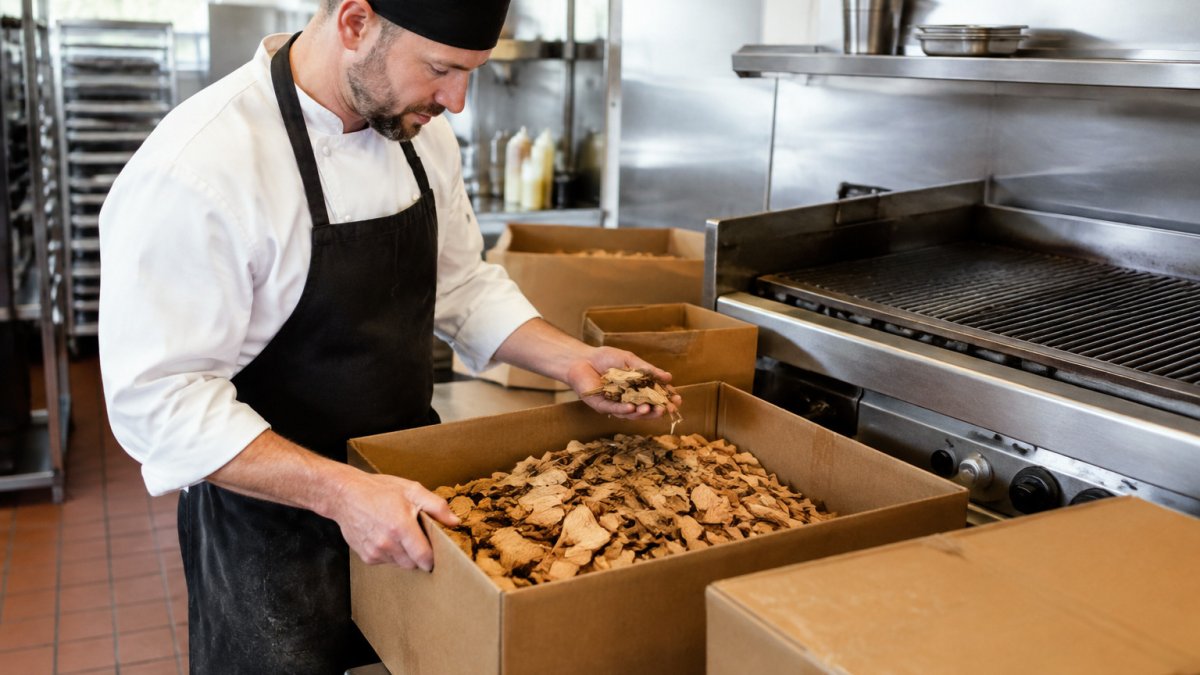
1. Estimate usage per wood, per week. Track how many pounds of each wood your kitchen actually burns across a full menu cycle, not a single busy night. A common pattern is that one protein family dominates volume, so one or two woods carry most of the load while a third is used sparingly for a signature item. Write the weekly pounds next to each wood on your recipe cards so purchasing and the line agree on the same number.
2. Convert sticker price to cost per cook. Compare formats by cost per pound, then by cost per cook. Our Bulk Maine Wild Apple Grilling Chunks are $35.99 in 15 lb and 45 lb boxes, while most chip boxes are $29.99.
3. Match format to equipment. Chips, chunks, logs, and pellets behave differently in each grill or smoker type, and format drives labor as much as flavor. Chips can be placed in a smoker box, and chunks can be placed directly onto the grilling surface. Confirm your smoker box or grill setup before committing to a bulk format. If your kitchen also runs charcoal, decide up front whether wood is the primary smoke source or a supplement, since that changes both the format and the weekly pounds.
4. Set a supply and storage standard. Choose box sizes that match how fast the kitchen actually uses a wood, and store boxes in a dry area.
Watch out: a supplier who cannot hold the same species and piece size across orders will quietly change your smoke profile mid-menu, and the line will compensate with vent and fuel adjustments that never get written down. A reliable supplier that ships on a predictable schedule is worth more to a restaurant than a small saving on any single box. If you are comparing wood types for a broader menu, our Best Wood for Smoking Everything: A 2026 Guide covers how different woods suit home and commercial cooking.
The article gives these bulk box sizes and prices for the Maine wood products it describes.
| Product | Box sizes | Price |
|---|---|---|
| Maine Atlantic Hickory Grilling Chips | 15 lb or 33 lb | Not stated |
| Maine Red Oak Grilling Chips | 10 lb or 33 lb | $29.99 |
| Maine Sugar Maple Grilling Chips | 10 lb or 33 lb | $29.99 |
| Maine Wild Apple Grilling Chunks | 15 lb or 45 lb | From $35.99 |
| Maine Yellow Alder Chips | 10 lb or 33 lb | $84.99 |
Frequently Asked Questions
What wood do most barbecue restaurants use?
Most barbecue restaurants rely on hickory, oak, and pecan because they produce a steady, mid-to-strong smoke that holds up over long cooks.
What wood is best for grilling?
The best grilling wood depends on the protein. Hickory suits beef and pork, red oak works well for poultry and white fish, and Maine yellow alder pairs naturally with seafood. Flame Grilling Products sells bulk hickory chips at $29.99 for a 15 lb box, so a kitchen can match each wood to a specific menu item and keep portioning consistent.
Which grilling wood works best with beef, pork, poultry, and seafood?
Hickory and beechnut suit beef because their smoke is strong enough to stand up to red meat. Sugar maple and apple wood complement pork and poultry with a gentle sweetness. Red oak and Maine yellow alder are better for seafood, since heavy smoke can overpower delicate fish.
Are wood chips, chunks, or logs best for restaurant grilling?
Wood chunks burn longer and suit extended smoking, while chips ignite quickly and work well for short grill sessions or smoker boxes. Chunks are typically packed in 15 lb or 45 lb boxes at $35.99 and up, while chips come in 10 lb or 33 lb boxes at $29.99. Most high-volume kitchens keep both formats so they can match the cooking method to each dish.
Bulk grilling wood box prices
