

Table of Contents
- Why Long Cooks Demand Different Smoking Woods
- Quick Comparison: Best Smoking Woods for Long Cooks
- Oak vs Hickory for Smoking: Which Wins the Long Haul?
- The Best Wood for Smoking Brisket on 12-Hour Cooks
- Apple Wood for Smoking: The Mild Fruit Wood That Lasts
- How Much Wood to Use for Smoking Meat (and When to Add More)
- Blending Woods and Keeping Smoke Clean Over Many Hours
- Conclusion
- Frequently Asked Questions
Last Updated: October 21, 2026
Why Long Cooks Demand Different Smoking Woods
A 14-hour brisket cook breaks most wood choices. Not because the flavor is wrong, but because the wood quits before the meat does. Chips flash out in 20 minutes.
At Flame Grilling Products, we've supplied smoking woods since 2001.
Below, we'll show you which woods last, how much to load, and how to keep smoke clean from hour one to hour fourteen.
Quick Comparison: Best Smoking Woods for Long Cooks
Here's how the top picks stack up on burn behavior, flavor intensity, and best use.
| Wood | Smoke Profile | Best For | Format & Price |
|---|---|---|---|
| Red Oak | Mild, nutty, hint of vanilla | All-purpose, brisket, poultry, cheese | Chunks $35.99 / Chips $29.99 |
| Hickory | Mild nutty, classic BBQ | Beef, pork, poultry | Chunks $35.99 |
| Pecan | Sweet, rich, nutty | Brisket, pork, chicken | Chunks $35.99 / Chips $29.99 |
| Apple | Sweet, fruity | Pork, beef, game | Chunks $35.99 |
| Black Cherry | Almond-sweet | Beef roasts, brisket | Chunks $35.99 |
| Sugar Maple | Sweetest of all smokes | Ham, turkey | Chunks $35.99 |
| Mesquite | Bold, sweet (northern grown) | Ribs, brisket, game | Chunks $35.99 |
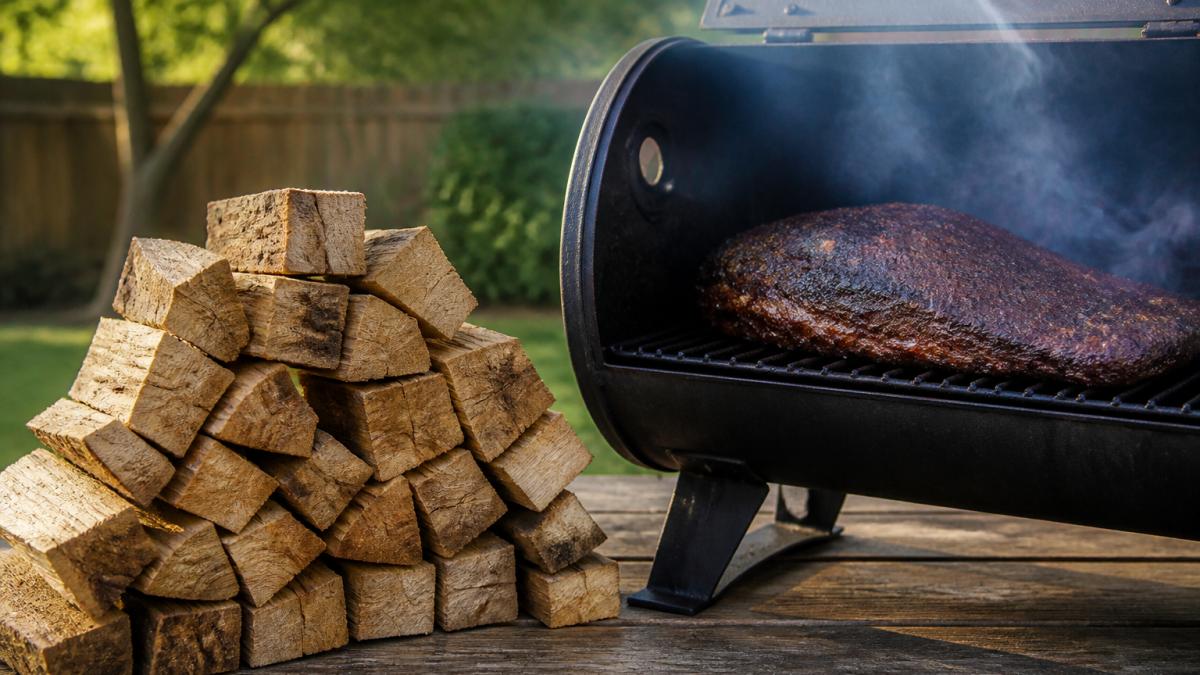
The uniform 3"x3" cut is the quiet hero here. Mixed-size chunks ignite at different times, so you get flare-ups and gaps in smoke. A consistent cut burns consistently.

Oak vs Hickory for Smoking: Which Wins the Long Haul?
Oak wins for long cooks, and it isn't close. Red oak delivers a mild, nutty smoke with a hint of vanilla that stays pleasant over 12-plus hours.
That doesn't make hickory a bad choice. Our Bulk Maine Atlantic Hickory Grilling Chunks are a classic for beef, pork, and poultry, and the mild nutty character takes the guesswork out of pairing.

The Best Wood for Smoking Brisket on 12-Hour Cooks
Pecan and oak are the best woods for smoking brisket, with pecan edging ahead for anyone who wants a sweeter, richer finish. Our Bulk Maine Northern Pecan Grilling Chunks bring a sweet, nutty smoke that beef absorbs beautifully, and the wood holds up for savory roasts and full packer briskets alike.

Black cherry is the sleeper pick. The almond-sweet scent of our Bulk Maine Black Cherry Grilling Chunks adds a unique layer to slow-grilled beef roasts and brisket. Blend it with oak and you get depth without the risk of an overpowering smoke.
Brisket needs steady smoke for the first several hours, then a cleaner burn as the bark sets. Plan to replenish, not to front-load.
Apple Wood for Smoking: The Mild Fruit Wood That Lasts
Apple wood is the mild fruit wood that holds its own on long cooks. Our Bulk Maine Wild Apple Grilling Chunks arrive fresh from nearby farmsteads almost daily, and they're built for long propane or smoking sessions.
Fruit woods in general run mild to medium in intensity. Apple and cherry sit at the gentle end, which makes them ideal for poultry and pork where you want smoke as a complement, not a blanket.
If you want fruit flavor to read clearly, keep the seasoning simple.
How Much Wood to Use for Smoking Meat (and When to Add More)
Most guides stop at "a few chunks." That's not enough to plan a 12-hour cook. The right quantity depends on three variables: your smoker type, the wood format, and how long the meat stays on. Here's a working framework you can scale.
Bulk Maine Red Oak Grilling Chunks →
Start With a Baseline by Smoker Type
- Offset stick burner: 2 to 3 splits (roughly 16-inch logs) to establish a coal bed, then 1 split every 45 to 60 minutes. Expect to burn through 8 to 12 splits on a 12-hour brisket.
- Charcoal drum or kamado: 3 to 4 fist-sized chunks buried in the charcoal at the start. A kamado often holds clean smoke for 4 to 6 hours before needing another 1 to 2 chunks.
- Pellet smoker: No manual wood needed, the hopper feeds the fire. Plan on roughly 1 to 1.5 pounds of pellets per hour at 225°F, so a 12-hour cook consumes 12 to 18 pounds. Fill the hopper before bed and check it at the halfway mark.
Burn Duration by Wood Format
Format matters as much as species. A dense oak chunk and an oak chip are not interchangeable on a long cook.
| Format | Typical burn window | Replenishment cadence | Best use |
|---|---|---|---|
| Chips | 15-30 minutes | Every 30-45 minutes | Short grills, smoker boxes, adding a quick smoke burst |
| Chunks (3"x3") | 45-90 minutes | Every 45-60 minutes | The workhorse for long cooks in drums, kettles, and cabinets |
| Logs / splits | 45-75 minutes per split | 1 split every 45-60 minutes | Offset stick burners running a real fire |
| Pellets | Continuous feed | Refill hopper every 4-6 hours | Pellet smokers; set-and-forget long cooks |
Those windows assume dry, seasoned wood and a fire running in the 225-275°F range. Green or soaked wood smolders longer but produces dirty smoke.
A Replenishment Schedule You Can Actually Follow
Watch the exhaust, not the clock, but use time as a backstop:
- Hours 0-2: Establish the fire with your starting load. Don't open the lid to "check." Let the coal bed and first chunks settle into thin blue smoke.
- Hours 2-6: Add 1 to 2 chunks (or 1 split) every 45 to 60 minutes as smoke thins. This is the window where bark forms, steady, moderate smoke matters more than volume.
- Hours 6-10: Continue the cadence, but taste the smoke in your head: if the exhaust has been heavy, back off to 1 chunk per hour and open vents slightly.
- Hours 10-finish: Many pitmasters wrap at this point (butcher paper or foil). Once wrapped, wood smoke can't reach the meat, so stop adding wood and just hold temperature.
Signs You're Under- or Over-Wooding
- Under: exhaust is clear for long stretches, bark looks pale and dry, and the meat lacks a smoke ring after 4+ hours. Add a chunk and verify airflow.
- Over: exhaust is thick and white, bark tastes acrid or ashy, and the firebox smells sharp rather than sweet. Stop adding wood, open vents, and let the fire burn clean before the next addition.
Blending Woods and Keeping Smoke Clean Over Many Hours
Blending is where long cooks get interesting. Here are ratios and combinations that can be used over 10-plus hours.
Blend Ratios That Work on Long Cooks
The principle: a mild, dense wood carries the heat and baseline flavor, and a bold wood seasons it. As cook time increases, the bold share can be adjusted.
- Brisket (12-16 hours): 75% oak, 25% pecan. Pecan's sweetness can be a good addition. Swap in 15% cherry for a fruit-forward variant.
- Pork butt (10-12 hours): 70% apple or cherry, 30% hickory. The fruit wood can complement the bark; hickory can provide a classic barbecue backbone.
- Poultry (4-6 hours): 80% apple or maple, 20% cherry. Consider skipping hickory and mesquite entirely for poultry, as poultry skin can absorb smoke quickly.
- Beef ribs (6-8 hours): 60% oak, 40% hickory. Shorter cook, so the bold wood can carry more of the load.
A practical way to execute a blend: layer the mild wood as your base load, then add the bold wood in smaller pieces at each replenishment. That can stagger the flavor release.
Why Dirty Smoke Forms Over Many Hours
Clean smoke is related to combustion. Wood produces visible white smoke when it's smoldering, starved of oxygen and burning below the temperature needed for complete combustion. Over a long cook, three things can contribute to smolder:
- Ash buildup. Ash insulates the coal bed and restricts airflow through the firebox. On offsets and drums, rake or shake the ash basket every 3 to 4 hours.
- Wet or green wood. Moisture absorbs heat as it evaporates, dropping fire temperature and producing steam-laden white smoke. Seasoned wood burns clean; soaked chunks can produce dirty smoke.
- Choked vents. Closing intake vents to drop temperature also starves the fire. Make small vent adjustments and give the fire 10-15 minutes to respond before adjusting again.
The Clean-Smoke Checklist
- Fire temperature: Aim for a small, hot, efficient fire rather than a large, cool one. Thin blue-gray exhaust is often considered a visual signal of complete combustion.
- Airflow: Intake and exhaust both open enough to move smoke through the chamber. A smoldering fire with the exhaust wide open can still run dirty if the intake is closed.
- Wood moisture: Dry, seasoned wood only. No pre-soaking, soaking can delay ignition and produce steam.
- Fuel bed: Keep coals hot and ash cleared. A dying coal bed can be a cause of dirty smoke in a long cook.
Conclusion
Long cooks require careful attention. The wood that works for a 30-minute grill session may not be suitable for a 12-hour brisket, and density, uniform cut, and disciplined replenishment are key.
Pick a dense base wood like oak or pecan, add a bold accent, and keep the fire clean. Browse our Bulk Maine Red Oak Grilling Chunks to start your next long cook with wood that lasts the distance.
Frequently Asked Questions
What is the best wood for a long smoke?
Oak and pecan are the safest choices for a long smoke because they burn slowly and produce a steady, moderate smoke that does not turn harsh over 10 to 14 hours. Hickory works well too, but use it in smaller amounts since it runs stronger. Fruit woods like apple and cherry are fine for long cooks if you blend them with a hardwood base. The key is uniform chunk size, which is why Flame Grilling Products cuts its smoking woods to roughly 3x3 inches for an even burn.
Which smoking wood burns the longest?
Dense hardwoods burn longest. Oak, hickory, pecan, and mesquite all hold heat and smolder for hours, while apple, cherry, and alder burn faster and are better used as flavor accents. Wood format matters as much as species: chunks last far longer than chips. Flame Grilling Products sells its smoking woods in 15 lb and 45 lb boxes of chunks, and the larger format is what keeps a fire going through an overnight brisket without constant reloading.
Is oak or hickory better for long cooks?
Oak is the more forgiving option for long cooks. Its mild, nutty smoke stays pleasant over 12 or more hours, and it pairs with beef, pork, and poultry without overpowering them. Hickory delivers a stronger, bacon-like flavor that can turn bitter if you keep feeding it for too long. Many pitmasters use oak as the base and add a few hickory chunks early for depth. Flame Grilling Products sells both as bulk chunks at $35.99 per box.
How much wood should I use for a long cook?
Start with three to four chunks for a cook under six hours, and add two to three more every 90 minutes to two hours on longer smokes. For a 12-hour brisket, plan on roughly 8 to 12 chunks total, depending on your smoker. Keep the chunks around the perimeter of the fire so they light gradually rather than all at once. A 15 lb box of Flame Grilling Products chunks covers several long cooks.
How do I keep smoke from tasting bitter during a long cook?
Bitter smoke comes from dirty combustion, not from too much wood. Keep your fire small and hot, leave the exhaust vent open so smoke keeps moving, and avoid smoldering chunks under a closed damper. Thin blue smoke is what you want; thick white smoke means the wood is starved of oxygen. Replenish with two or three chunks at a time rather than dumping in a full load, and let the wood catch before closing the lid.